
Illinois 24-Hour Arrests Are Local
Illinois runs its same-day arrest picture through local systems. No uniform 24-hour booking window covers all counties. Some jails report bookings within a stated interval. Others simply list who is in custody at a given moment. A municipal search covers that department's adult arrests. A county roster, meanwhile, shows people held at the county jail.
Timing matters here. A daily report can close before intake finishes. A current roster can drop someone after release or transfer. A city arrest may also surface in a county jail record, though never in the same system. Read each source's date, update label, and record type literally, because current custody, daily booking, and arrest log are distinct things.
Route an Illinois Arrest Search Today
Start with the arrest location. A statewide name-only search will not get you far. The arresting agency's report may show where the person was taken. The official Illinois County Directory routes to county sources. For a city arrest, check city police and the receiving jail too.
- Pin down the place. Note the city or county and arresting agency. A state police release may name a county facility; a city search may cover only that department’s adult arrests.
- Choose the record. Use a daily report for its stated interval, or a custody locator to learn whether someone is still held. Neither is an all-arrests archive.
- Check its details. Note the date, fields, cutoff, or processing notice. Try reasonable name variations, then check another relevant city or county source if needed.
- Ask the custodian. Use the jail’s official records line for a current-custody question. For a record copy, contact the agency records staff and request a specific existing item, such as a booking sheet or arrest report, with the known date, place, and agency.
A clear route leads to the right local arrest record, though not every agency posts a same-day roster. When no public booking list or date-bounded report exists, contact the official records office for the arrest record you need.
Illinois Same-Day Booking Views Compared
These official examples show why "arrested today" must be read county by county. "Daily" may mean an interval, a morning snapshot, or a live custody page rather than one statewide cutoff.
| Official view | What its timing means | Fields and photo limits |
|---|---|---|
| Adams County jail list and Daily Population Sheet | The sheet is a morning population snapshot, observed around 6 a.m., not a rolling 24-hour archive. | Rows can show a booking ID, charges, bond, court date, time and room, plus “Front Mugshot” when supplied. A person released before the snapshot may be absent. |
| Champaign County Inmate Bookings Report | The report spans a prior-day-to-morning interval and is not a permanent same-day archive. | Observed columns include authority or warrant, SO number, name, description, confined status, arresting agency, charges, bond, and image. An image field does not mean every row has a photo. |
| Cook County Individual in Custody Locator | The sheriff describes booking processing as commonly taking about four to six hours. This is current custody, not a complete county arrest window. | It answers a custody question after processing; a delay or release can affect what appears. |
| Chicago Police adult arrest search | A city agency’s adult-arrest search, not a Cook County-wide roster. | Fields include date and time, central booking, charges, location, release or bond details, and photo-related fields. It does not include arrests by the sheriff, state police, or other suburbs. |
| McHenry County Sheriff’s date-based jail report | The observed route is timestamped and date-based. It does not promise a universal “last 24 hours” period. | Photos appeared in observed official report views. The research did not verify a fixed image-retention rule. |
| St. Clair County Inmate Search | The county describes an hourly update, but the search is current custody with no bounded chronological window. | A public photo policy was not verified, so a photo should not be expected from the description alone. |
| Rockford Police seven-day arrest log | A city log with a seven-day period, not a same-day Winnebago County booking feed. | Its rules allow a possible 72-hour hold for sensitive or narcotics material. It is not a countywide photo roster. The wider statewide Arrest Log page covers multi-day records and blotters. |
Many counties have no public roster or date-bounded PDF. A sheriff site may offer contact or FOIA details but no jail view at all. Other pages cover visitation or bond only. A missing web view does not mean the custodian lacks the record.
What the Illinois Same-Day View Shows
Illinois has no standard result card. Keep the arrest event, booking, and current custody separate. Official examples show varied fields, but no single page promises every item.
| Field | What it can show | Where it varies |
|---|---|---|
| Name and identifier | Name on the entry and, where provided, a booking ID or sheriff’s office number. | Adams and Champaign show identifiers; a search page may ask for a name. |
| Date, time, and location | When the arrest or booking was recorded and where it occurred. | Chicago lists date, time, and location. A report’s posting time may differ from arrest time. |
| Agency and authority | The arresting agency or a warrant/authority field tied to booking. | Champaign lists both. A county roster can include bookings by several agencies. |
| Charge and bond | Booking-stage charges and any listed bond amount or type. | These are not a court finding; a later filing or disposition may differ. |
| Custody status | Whether the person is shown as confined or currently held. | A live roster may drop a person after release; an interval report may retain the row. |
| Court details | A listed court date, time, or room. | Adams’s sheet is one verified example, not a universal field. |
| Photo or image | A booking image included in the public view. | Adams or Champaign image fields do not guarantee a photo or statewide policy. |
Illinois law lists a photograph "when and if available." No jail is required to publish an image. A blank photo field may reflect local practice or a record limit, not a missing arrest record.
Why Illinois Bookings Post Later
Delays are built into the process. Arrest, transport, intake, and publication are separate steps. Intake may finish after a report cutoff. Release or transfer can remove someone from a current-custody page. Cook County's four-to-six-hour estimate applies to its locator only, not every Illinois jail.
The Cook County locator page displays the Individual in Custody Locator and its terms panel, not a live booking result.
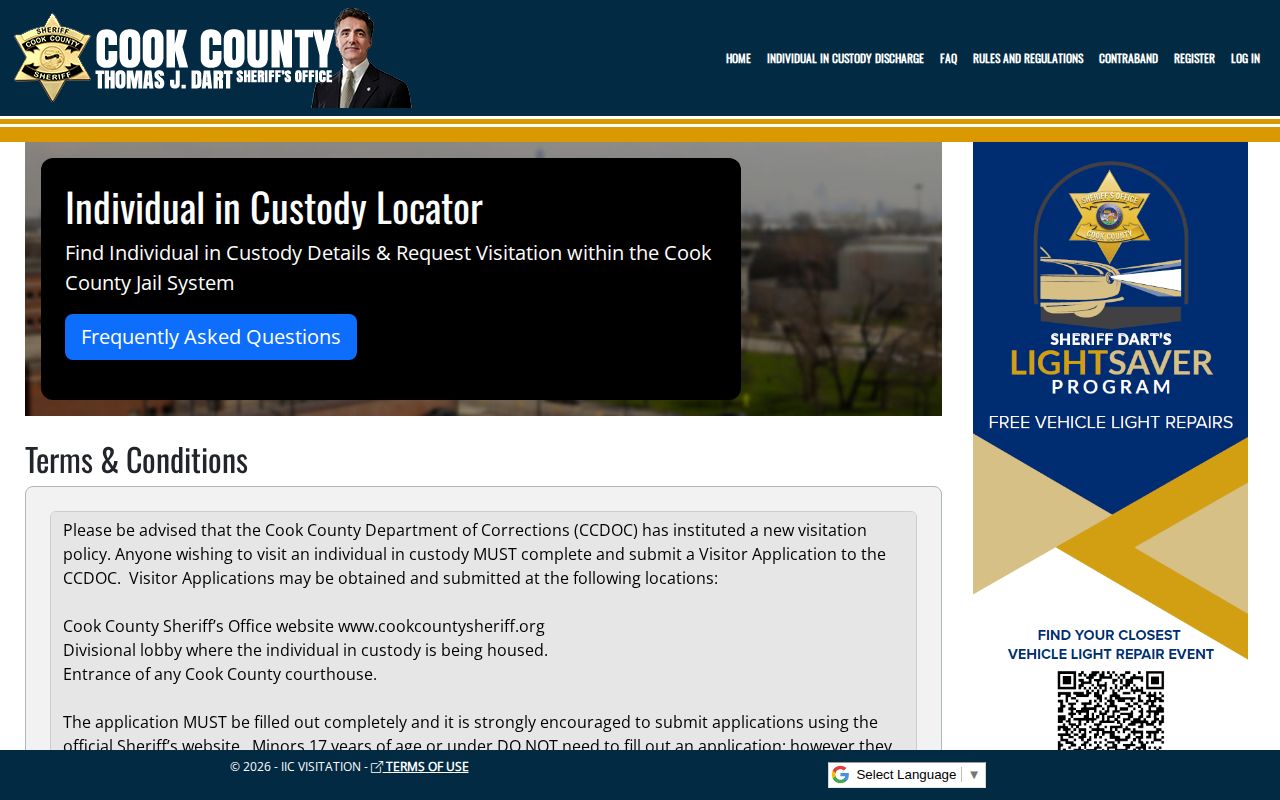
That page does not set a posting schedule. Check the live locator when a fresh booking is not visible, and contact the jail through its official route.
Illinois Arrest Photos Depend on the Custodian
Photo access varies locally. Adams County labels a "Front Mugshot" field. Champaign County has an image field. Photos were visible in Cook County, Chicago Police, and McHenry views. None of this means every county posts a photo. Nor does it mean a county keeps one online for a set period.
For a narrow restriction on certain law-enforcement social-network posts, see 5 ILCS 160/4a. It is not a statewide roster rule or a requirement to publish booking images.
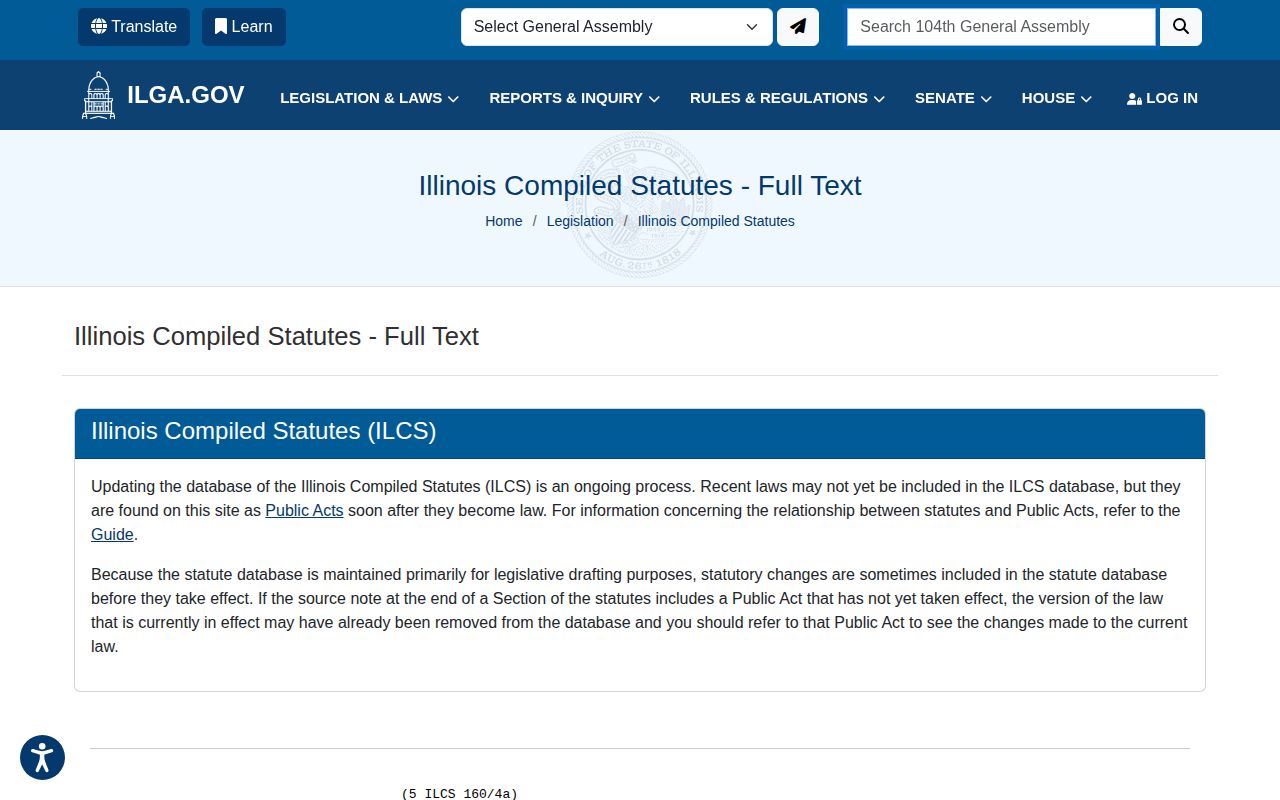
The statute addresses one publication channel. Local jail image fields and public arrest-record access remain separate questions. The Chicago Police arrest search covers that department's adult arrests, with date and time, central booking, charges, location, release or bond, and mugshot-related fields.
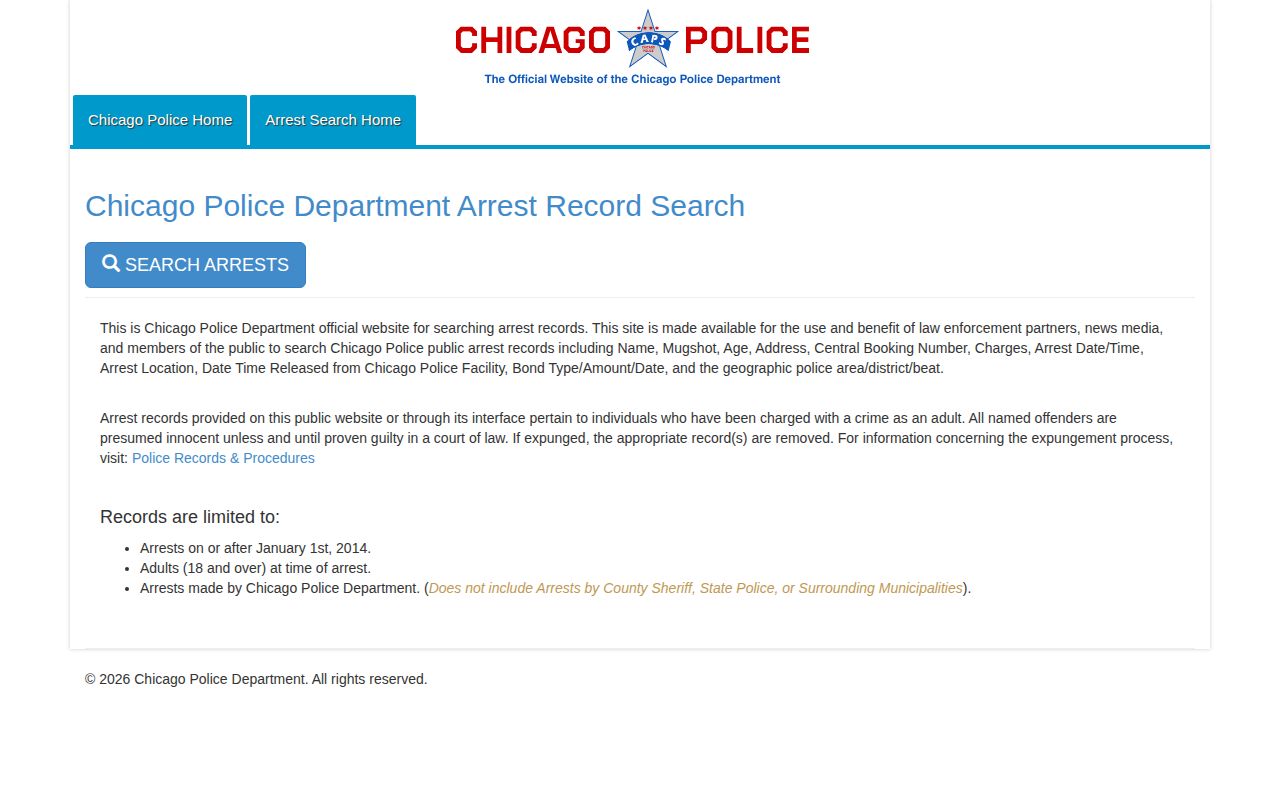
The search excludes arrests by Cook County Sheriff, Illinois State Police, and suburban departments. St. Clair describes hourly custody updates. Its public photo policy is another matter. A photo appears only when the local custodian makes one available.
Note: An official photo field is a publication choice by the custodian, and no single Illinois image rule describes every county's public interface.
Routing an Illinois Arrest to Its Record
The arresting agency holds its incident or arrest report. The receiving jail creates the booking and custody entry. A circuit clerk holds the filed case. A police release may be the first public result, while the current custody answer sits with a county facility. ISP's ENF-014 transport directive describes transfer to a receiving facility and delivery of booking documents. Official examples name Macon County Jail and Will County Adult Detention Facility or Clay County Jail. These illustrate the handoff, not a fixed destination for every ISP arrest.
Use the named destination when a report provides it. Otherwise ask the arresting agency which facility received the person. A jail roster answers current custody in that system. The arrest report documents the event itself.
Note: An arrest at one location can lead to booking elsewhere, so search the receiving county as well as the agency's own record.
When an Illinois Arrest Search Finds Nothing
A blank result is not a clean bill. It means no match at that moment. The person may have been released, transferred, or simply not booked into that system yet.
A daily PDF may have cut off. The query itself may be the problem. A wrong county or spelling returns nothing.
Illinois law adds other reasons an arrest stays out of public view. Juvenile confidentiality is one. So is a sealed or expunged record, or a limit tied to an open investigation.
For a firm answer, ask the arresting agency or the receiving jail for a specific booking sheet, since no public body must build a statewide roster. FOIA's arrest-information rule, 5 ILCS 140/2.15, covers name, age, address, photo when available, charges, time and place, agency, and certain custody events, due as soon as practicable and within 72 hours. The statute still promises no instant statewide page, and a saved St. Clair County Inmate Search page shows a verification screen rather than records.
That screen is not a custody result. It says nothing about whether a person is listed, so retry later or contact the custodian, and it proves nothing about the county's photo policy.