
Illinois State Police Arrest News
The ISP newsroom serves as the state's arrest publication layer. Releases cover investigations and traffic stops. DUI enforcement, warrants, and fugitive notices appear there too. Fatal crashes and troop activity round out the mix. A dated release may summarize an event, list an offense, or share arrest details. Some include an agency contact or a receiving county. What appears depends on the case. ISP chooses what to publish. The newsroom is selected information, not a complete list of everyone ISP arrested. State-level news covers only part of the picture.
When a release names a local jail, that county's page is the next stop for a current custody check. Silence does not mean no arrest happened. Agencies do not write a news item for every arrest. ISP posts no statewide booking or dispatch log either. Some releases describe coordinated operations that cross county lines; others close out a public event. These items identify the responsible ISP unit and the agency's account. They are not always the record custodian for a person's current location. Keep the release date, event date, and any later court date distinct when building a timeline.
What ISP Publishes About Arrests
Each ISP channel serves a different purpose. Read their labels and publication dates as written, since none functions as a live county booking feed.
| Official Channel | Useful For | Coverage Limit |
|---|---|---|
| News Releases | Named investigations, arrests, enforcement operations, troop activity, and agency statements. | Selected releases; not a daily roster, hourly log, or complete case file. |
| Press Releases by Year | Finding dated items in an annual archive when the current newsroom has advanced. | Archive presence depends on an item being published; it does not prove no arrest if no result appears. |
| Impaired-driving information | Understanding ISP DUI prevention and enforcement work. | Program information, not a complete list of DUI arrests. |
| Dated enforcement results | Details about a particular multi-day or regional initiative. | One event’s announced results, not a daily statewide activity dataset. |
| FOIA page and request form | Asking for an existing report, document, recording, or other releasable file. | Specific records may be redacted, delayed, or withheld under an exemption. |
Open the ISP Arrests page for current publications. The year archive helps here. A dated announcement can slide off the current listing over time. The ISP newsroom index shows the agency's release format. Its publication list is dated. ISP leans on its troop structure and public-information channels as well. Social posts and news items are chosen communications, not a substitute for jail intake data.
Check the release date and named troop or county before routing a record request. The index is not a statewide booking search.
ISP Troop Coverage and Arrest Reporting
ISP runs ten troops. A release naming one gives readers a geographic clue. Troop 1 covers Rockford, Troop 2 Moline, and Troop 3 Chicago. Troop 4 sits around Peoria, Troop 5 Bloomington, and Troop 6 Springfield. Troop 7 covers Champaign, Troop 8 Metro East, Troop 9 Effingham, and Troop 10 Carbondale. The statewide agency also works across troop lines. Investigations and campaigns cross those borders too. A release's originating unit may not match the county where the receiving jail sits. The ISP transparency page lays out the troop structure. Newsroom announcements often name the relevant troop too. Treat a troop name as a routing hint, not proof of the arrest county. A state trooper can investigate one area. Coordination with local agencies is common. An arrestee may be transferred elsewhere. The receiving institution and its roster decide what custody details come next.
- Troop 1: Rockford
- Troop 2: Moline
- Troop 3: Chicago
- Troop 4: Peoria
- Troop 5: Bloomington
- Troop 6: Springfield
- Troop 7: Champaign
- Troop 8: Metro East
- Troop 9: Effingham
- Troop 10: Carbondale
This list is a navigation aid, drawn from ISP's published troop structure. It does not map every patrol boundary. One release can name a city, a county, and a troop, each describing a different part of the event.
Where ISP Arrestees Are Booked
ISP runs a statewide police agency. It does not operate a public county-jail roster. Its prisoner-transfer directive covers the handoff after an arrest. Officers secure the arrested person at a receiving facility, deliver arrest and booking documents, and get acknowledgment from detention staff. That handoff makes the destination county matter. A name can be absent from the newsroom while the receiving jail holds the booking file, and a release can name a county facility even after the person's status changes.
The ENF-014 prisoner-transfer directive spells out the paperwork and receiving-facility handoff. Published releases show the routing in practice. One names the Macon County Jail. Another identifies the Will County Adult Detention Facility and the Clay County Jail. These are examples, not a statewide facility list. Use the county and facility named in the release. Then check that jail's own custody page for current status and image policy. Release, transfer, or a move can happen before you look.
Transfer paperwork stays separate from the public release. The receiving facility keeps its booking number, custody status, and intake image in a jail-management system. ISP keeps its own incident or investigative record. A release might not name a booking identifier, and a county roster may roll off before a report is requested. If the jail cannot locate the record, ask which agency completed the booking or whether the person was transferred elsewhere.
A booking photo question starts at the county facility that received the person. So does present custody. The Illinois State Police report describes the event itself, while the jail's own roster holds the current status.
The receiving-county route sits in the Illinois County Directory. The same-day arrest guide explains why county booking windows and update times cannot be assumed to match ISP release times.
How to Request an ISP Arrest Report
Not every arrest becomes a news release. For the rest, file a FOIA request with ISP. Describe one specific existing record, with enough detail for staff to locate it. Skip broad "any and all" wording, since an unclear search forces clarification and slows the response.
- Identify the record type: an arrest or incident report, investigative file, audio, dash-camera recording, video, or another specific document.
- Provide the date or reasonable date range, location, names, and ISP report or case number if known. Include identifying detail only when needed to find the correct record.
- Use the ISP FOIA guidance and submit the agency’s document and audio request form to the ISP FOIA Officer.
- Request electronic delivery where available, ask for a fee estimate, and keep the submission and the written response.
- If material is withheld or blacked out, ask which exemption supports the decision and whether nonexempt portions can be released.
An ordinary request gets five business days under Illinois FOIA. A written extension is also possible in some cases. Commercial requests run on a separate 21-business-day track. Those are deadlines for answering, not promises of a copy. Active investigations, personal privacy, safety, and other statutory grounds can support a redaction or withholding. Section 2.15 sets a separate floor for arrest records. It covers public arrest information and photographs when available. The official section 2.15 text lays out that statewide rule and its limits.
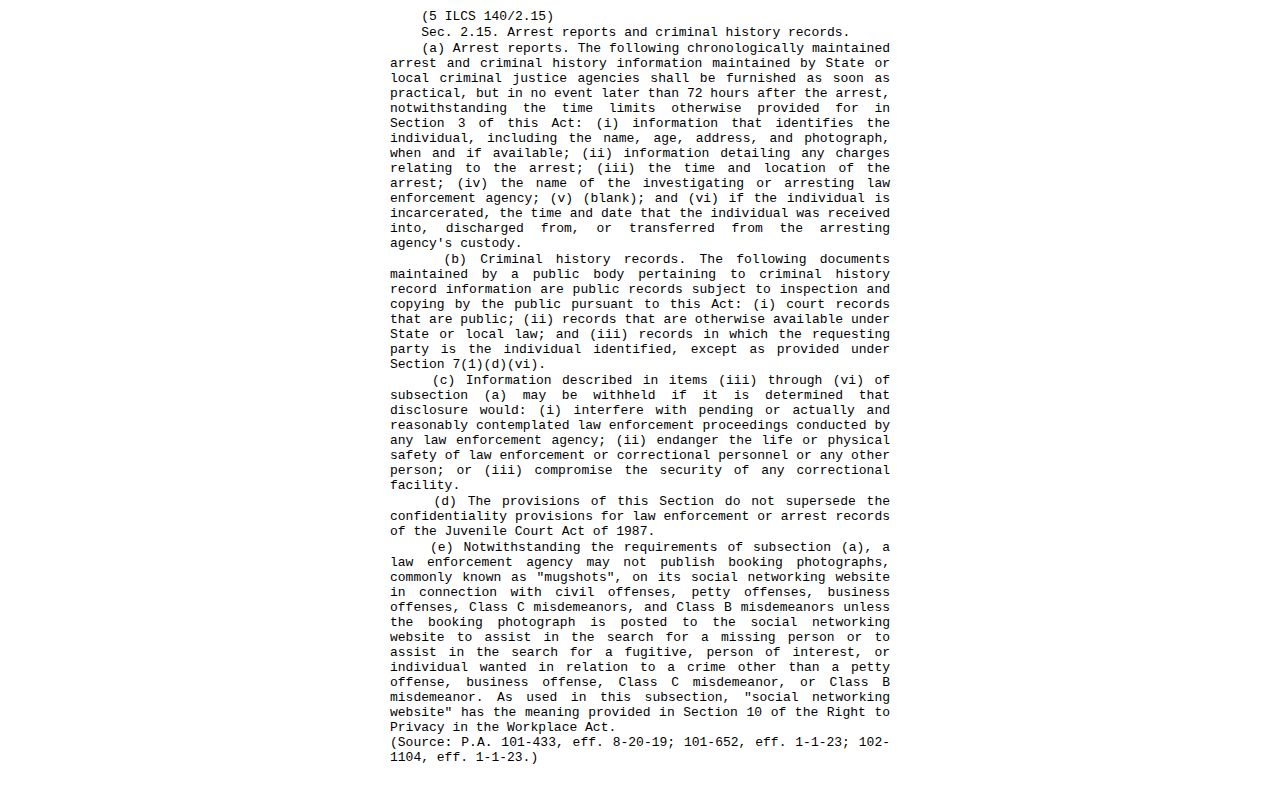
That rule governs what a public body furnishes; it does not turn ISP's newsroom into a statewide booking feed.
Certain imaging products carry charges under 20 Ill. Adm. Code 1298. ISP may send a fee notice first. Its materials direct payment by check or money order. Some documents ship only after payment lands. No single arrest-report price or guaranteed turnaround fits every request. Confirm the amount on the agency's response rather than assuming a standard photo charge.
Separate the announcement from the file. A published release already shows who ISP named and what it chose to report. A full incident report, interview, audio recording, or investigative attachment is a different request. It may involve deeper searching or statutory withholding. Narrow the date range and location. Ask for the record in electronic form. If an exception is cited, request any releasable nonexempt portion.
ISP DUI and Traffic Enforcement Releases
ISP's impaired-driving material covers prevention and enforcement work. Dated newsroom items report individual operations. A multi-day initiative may list arrests, citations, warnings, and the participating areas. Read the date range and geography closely. A campaign summary is not a daily statewide DUI roster, so an unlisted arrest simply is not in it.
The ISP impaired-driving page adds program context and definitions for that enforcement work.
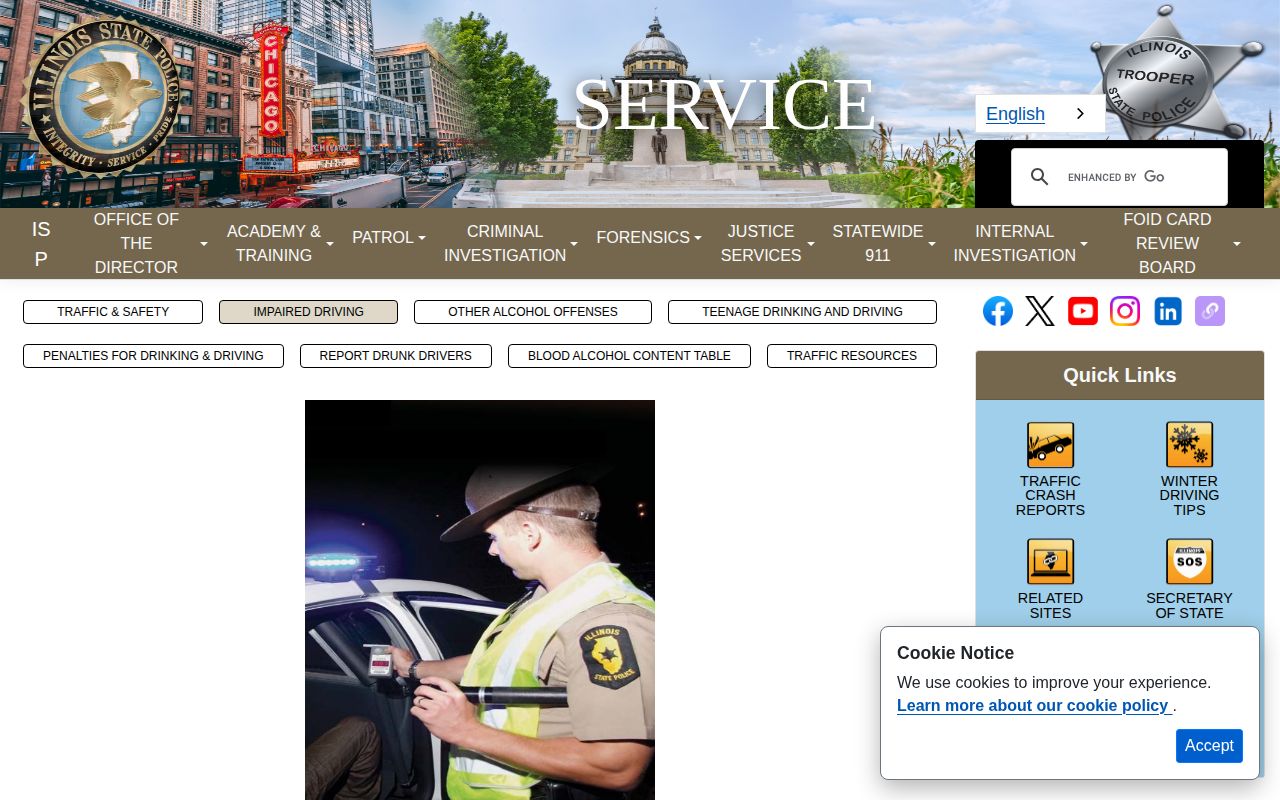
Use dated releases for event numbers. Booking details and current custody live in the receiving county's system. The multi-day Central Illinois enforcement release documents one defined period and its announced results.
That example shows the agency's announcement style. It is not a complete arrest log, so keep each operation's details tied to its own date and area.
When No ISP Arrest Result Appears
ISP publishes no statewide daily activity or dispatch log. The news stream runs on selected releases. Its archive reflects what the agency chose to publish. A routine arrest may generate no announcement at all. An investigation may surface only after a later development. A missing name has many explanations. The search term may be too narrow. The entry may sit in an older archive, under a different agency, or nowhere at all. None of that means no arrest happened.
Start with the current release list. Move to the year archive if the event date is older. Search by county, troop, operation, or case detail along with a name. A release may point to a county facility, so check that local roster and note its last-updated time. When online searching stalls, contact the ISP FOIA Officer or the receiving jail's records custodian. A local roster can show a booking with no investigative narrative. An ISP report can explain an arrest without a current custody status.
For a copy request, say whether your date is the arrest date, an investigation date, or the release date. Add a location and unit when you have them. Identify whether you need the arrest report or a media item. That separates a record search from a request for something already published. If a release names a jail but its page shows no entry, the jail and ISP answer different parts of the question.
Keep the agency layers separate as you follow an event. ISP can be the arresting agency, a county sheriff can hold the booking record, and a circuit clerk can hold the filed case. A later disposition can differ from the initial release.